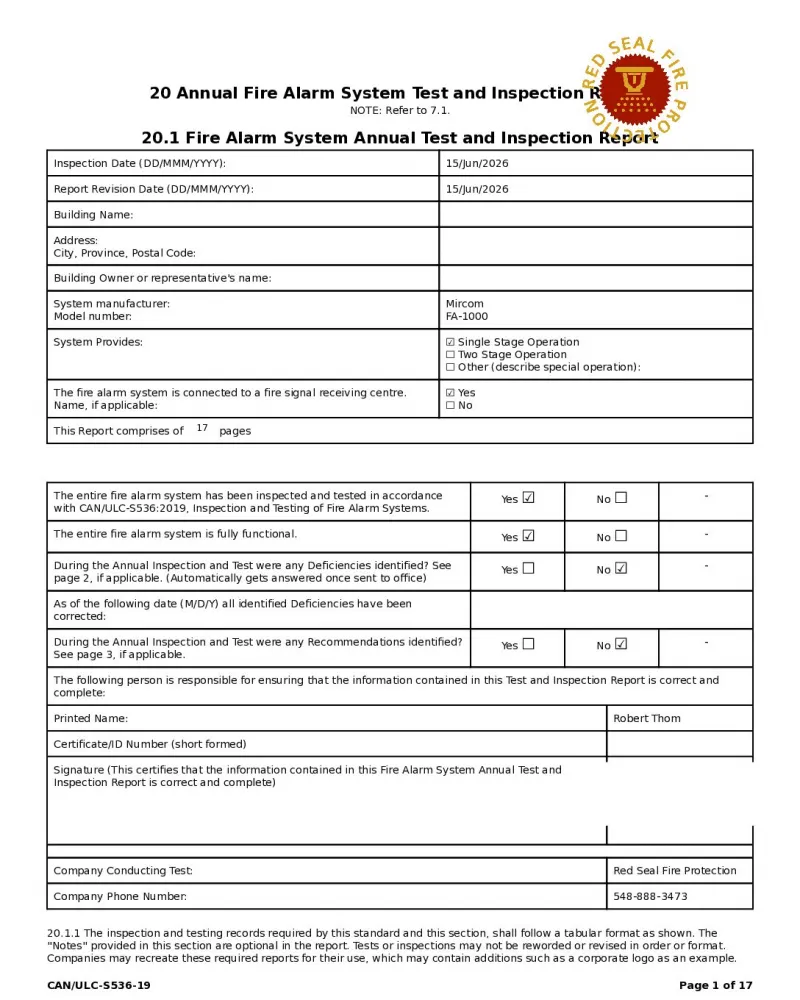
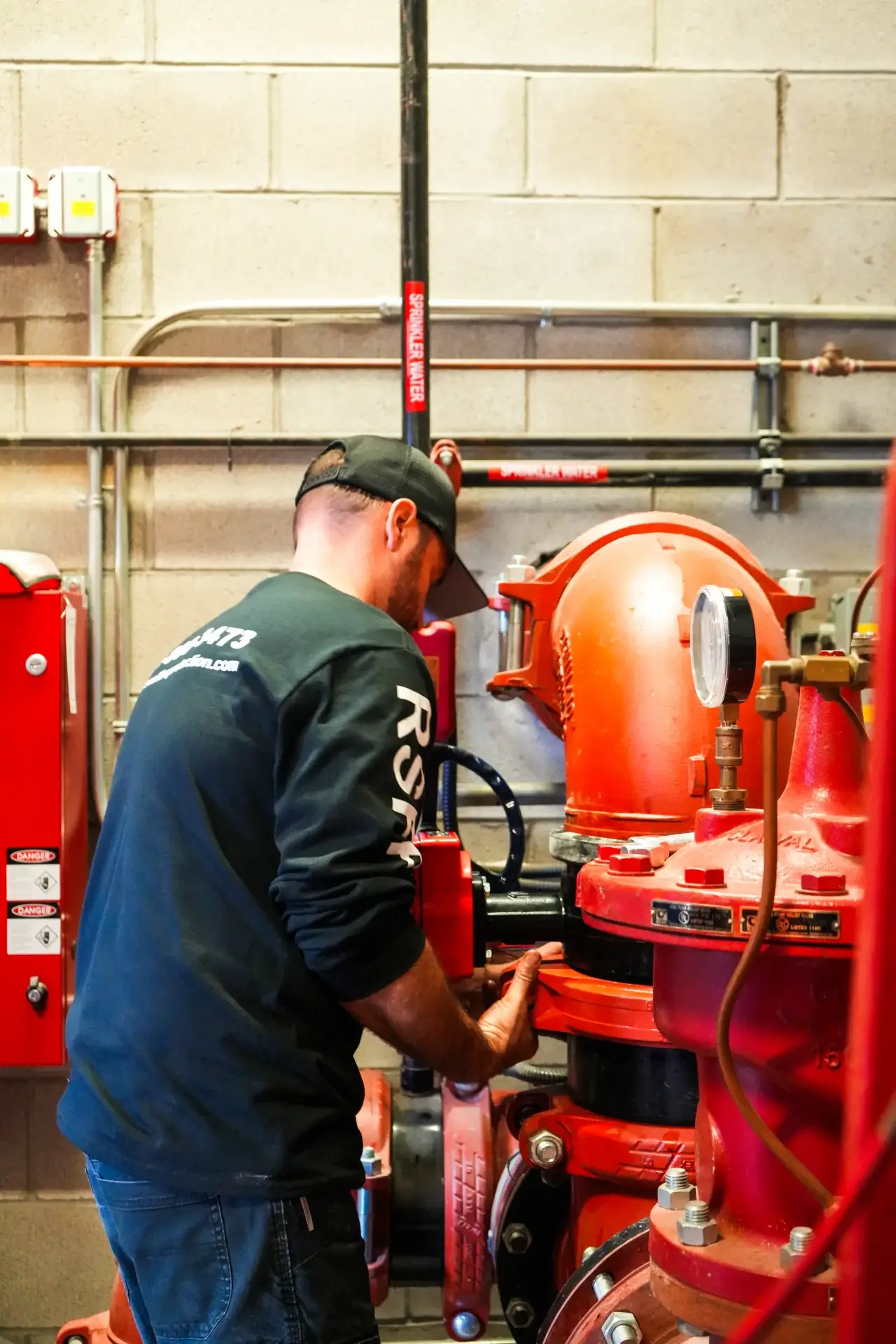
A fire protection service agreement is a 12-month contract that puts every inspection and test a building needs on one schedule with one contractor. It covers the frequencies the Ontario Fire Code sets: NFPA 25 for sprinklers, standpipes and fire pumps, CAN/ULC-S536:2019 for fire alarms and NFPA 10 for extinguishers.
Red Seal’s agreements run 12 months, renew automatically, and have rates reviewed at renewal with 30 days’ notice. Buying PO by PO works for a building with one system and one visit a year. It stops working once the frequencies stack.
What does a fire protection service agreement actually cover?
Okay, so first things first. An agreement is a list of systems, the standard for each one, and the frequency each one is tested at. The reason being, the Ontario Fire Code does not have one inspection date for a building.
A wet sprinkler system has quarterly, semi-annual and annual items under NFPA 25. A fire alarm has a monthly test and an annual test under CAN/ULC-S536:2019. Extinguishers get a monthly look from your staff and annual maintenance under NFPA 10.
So what that means is a real agreement names each of those lines. It says who shows up, what they test, and what report you get. If an agreement does not list the standard and the frequency for each system, ask for one that does.
One thing to know: repairs are not inside the agreement, and that is normal. The inspection finds the deficiency, you get a quote, and you approve it before anyone touches a wrench. That keeps the agreement a schedule with a known rate, as opposed to an open tab.
The Red Seal version also includes the report within 24 hours of the visit, guaranteed within 48 hours or 20% comes off the inspection price. Every customer gets an online inspection portal with every past report and every deficiency resolution. The full terms are on the service agreements page.
How is buying PO by PO different from a 12-month fire inspection contract?
The big thing is who carries the calendar. On a PO, you do. On an agreement, the contractor does.
That sounds small until you count the dates. A building with a wet sprinkler system, a fire alarm, extinguishers and emergency lighting has at least four contractor visits a year, plus 12 months of staff checks. Multiply that by a dozen buildings and the calendar is a part-time job.
| PO by PO | 12-month agreement | |
|---|---|---|
| Who tracks the due dates | You do, for every system and every frequency | The contractor does, and books ahead |
| What happens when a quarter slips | A gap in the record, and the fire prevention officer is entitled to ask about it | The visit is booked before it is due |
| Rate for the year | Quoted each time you call | Set for the 12-month term, reviewed at renewal with 30 days’ notice |
| Paperwork | One PO and one invoice per visit | One agreement and one invoice schedule |
| Where the records live | With whoever did the work that time | Every report in one portal, two years and beyond |
| Emergency calls | Whoever answers the phone that night | A contractor who already knows the building |
| How it ends | Nothing to end | Auto-renews each year, with notice before the renewal |
I have met a property manager who tracked 14 buildings in a spreadsheet, and it worked. Then she went on leave for 3 months and one building missed a quarterly and a fire alarm annual. Nobody did anything wrong, as opposed to nobody owning the date.
When does an annual fire protection maintenance agreement pay for itself?
It pays when the frequencies stack, when the buildings stack, or when the history is messy. Here is how I would say it across a tailgate.
The frequencies stack when the building has more than one system. Add a fire pump and there are weekly items (NFPA 25 8.2.2). Add a commercial kitchen and there is a semi-annual suppression inspection under NFPA 17A.
The buildings stack when one manager runs a portfolio. A dozen buildings on PO means a dozen quote requests, a dozen approvals and a dozen chances to forget. One agreement means one renewal date and one person at the contractor who owns the whole list.
The history is messy when a building has been written up before. The Ontario Fire Code requires two years of records of tests, inspections and corrective measures (Division C, Section 1.1.2). An agreement rebuilds that record one visit at a time, with every report in the same place.
PO by PO is fine for the small single-system building. One annual extinguisher visit, one invoice, and an owner who will remember next year. I would not push an agreement on that building.
The schedule behind all of this is in how often a commercial building needs a fire inspection in Ontario. The staff items that stay with you either way are in the commercial fire inspection checklist.
What should the auto-renew and rate review terms say?
Read three lines before you sign. The term, the renewal, and how the rate changes. Everything else is scope, and scope is the easy part.
Red Seal’s terms are a 12-month term, automatic renewal, and rates reviewed at renewal with 30 days’ notice. So what that means is you know the renewal date a year ahead. You see any rate change in writing 30 days before it takes effect, and you decide then.
That is the whole point of the notice, as opposed to an agreement that renews quietly and shows a new number on an invoice in month 13. If an agreement you are reading does not say when it renews and how it tells you about a rate change, that is the question to ask first.
Records are the other term worth reading. Ask where the reports go and who can see them after the agreement ends. The retention rule is covered in how long to keep fire inspection records in Ontario.
Frequently asked questions
Is a fire inspection contract required by the Ontario Fire Code?
No. The Ontario Fire Code requires the inspections, the tests and two years of records (Division C, Section 1.1.2), and it does not care how you buy them. A contract is one way to make sure every frequency under NFPA 25, CAN/ULC-S536:2019 and NFPA 10 gets a date on the calendar.
What is in an annual fire protection maintenance agreement?
A list of every fire protection system in the building, the standard each is tested to, the frequency, and the rate for the term. Red Seal’s agreements run 12 months, renew automatically, and have rates reviewed at renewal with 30 days’ notice. Repairs are quoted separately after each inspection and approved before the work.
Does a fire protection service agreement include repairs?
No, and it should not. The inspection finds the deficiency, the contractor quotes the repair, and you approve it before the work. That keeps the agreement a fixed schedule and keeps you in control of what gets spent on repairs.
Who tracks the inspection dates under a fire protection service agreement?
The contractor does. Each system’s frequency is on the agreement, and the contractor books the visit before the date comes due. Your staff still do the monthly items, such as extinguisher checks and emergency lighting tests, and log them.
Does a 12-month agreement lock you in?
It locks in the schedule and the rate for 12 months, and that is the point. It renews automatically, but the rate is reviewed at renewal with 30 days’ notice, so any change reaches you in writing before it applies. You have the renewal date to decide, every year.
The proof that the service holds up is in the reports. Red Seal has done 3,000+ inspections in the last few years, each one reported within 24 hours, guaranteed within 48 hours or 20% comes off the inspection price. Every report sits in your portal.
In Chatham-Kent and Windsor-Essex an emergency call gets a technician in 2 hours. The Chatham-Kent service page has the local details, and the fire system inspections page lists what each visit covers.
Put every building on one calendar with one renewal date. Send your building address to Red Seal and get a fixed-fee inspection quote within 24 hours. Get a fixed-fee quote or call 548-888-FIRE (3473).
Red Seal Fire Protection inspects, tests and repairs fire sprinkler, fire alarm, fire extinguisher, fire pump and backflow systems for commercial, industrial and multi-residential buildings in Windsor-Essex, Chatham-Kent, Sarnia-Lambton and London, Ontario.