A fire inspection checklist for a commercial building in Ontario has four layers: monthly checks by your own staff, quarterly and semi-annual contractor tests, an annual inspection, and two years of records on site. The Ontario Fire Code (O. Reg. 388/97) sets the frequencies. It points to NFPA 25 for sprinklers, CAN/ULC-S536:2019 for fire alarms and NFPA 10 for extinguishers.
The fire prevention officer checks the records first and the equipment second. The table below is the full list, sorted by how often each item comes due.
What does a fire inspection checklist for a commercial building need to cover?
Okay, so first things first. The checklist covers every fire protection system in the building, at the frequency the code sets for that system. The reason being, the fire prevention officer does not inspect “the building” as one thing.
They inspect each system against its own standard. Then they ask for the record that proves it was done. So your list depends on what is inside your walls.
A strip plaza with extinguishers and emergency lighting has a short list. A 6-storey office with a wet sprinkler system, a fire alarm, extinguishers, emergency lighting and a fire pump has a long one.
One thing to know: the Ontario Fire Code puts responsibility for compliance on the owner (Division C, Section 1.2). A lease can pass the work to a tenant. The owner still answers to the fire department, so the checklist is yours to run.
Which checks can your own staff do, and which ones need a contractor?
The big thing is the split. Monthly items are mostly visual. A building operator can do them with a clipboard in about 30 minutes.
Quarterly, semi-annual and annual items involve flowing water, sounding alarms or opening equipment. Those need a licensed sprinkler fitter, a certified fire alarm technician or an extinguisher technician. Here is the full checklist, so print it and tick the rows off as they come due.
| Frequency | What to check | Standard | Who does it |
|---|---|---|---|
| Monthly | Every extinguisher: in place, visible, pin and seal intact, gauge in the green, tag initialled and dated. Emergency lighting: press the test button and confirm the heads light. Fire separation doors: close and latch on their own, nothing propping them open. Sprinkler gauges reading normal pressure. Every sprinkler control valve open and locked, or electrically supervised. Fire alarm panel: no trouble light (this one is daily) and the monthly test logged. | NFPA 10; Ontario Fire Code Division B 2.7.3; Ontario Fire Code Division B 2.2; NFPA 25 13.2.7.1.1 and 13.3.2.1.1; Ontario Fire Code Division B 6.3 and CAN/ULC-S536:2019 | Building staff, logged on a sheet or in your portal |
| Quarterly | Waterflow alarm test: inspector’s test valve opened, the bell or panel signal confirmed, monitoring station confirms receipt. Supervisory alarm test on every supervised valve. Fire department connection: caps on, couplings turn, nothing stored in front of it. Standpipe hose valves: caps and threads checked. Electrically supervised control valves inspected. | NFPA 25 5.2.4, 13.2.8.1, 13.2.6.1.2, 13.8.1, 13.6.1 and 13.3.2.1.2 | Licensed sprinkler fitter |
| Semi-annual | Commercial kitchen suppression system inspected and serviced. Hood and duct cleaned as needed. Vane-type and pressure-switch waterflow tests. Valve supervisory switch test. | NFPA 17A; NFPA 96; Ontario Fire Code Division B 2.6 and 6.5; NFPA 25 13.2.6.2.2 and 13.3.2.1.3 | Kitchen suppression technician; licensed sprinkler fitter |
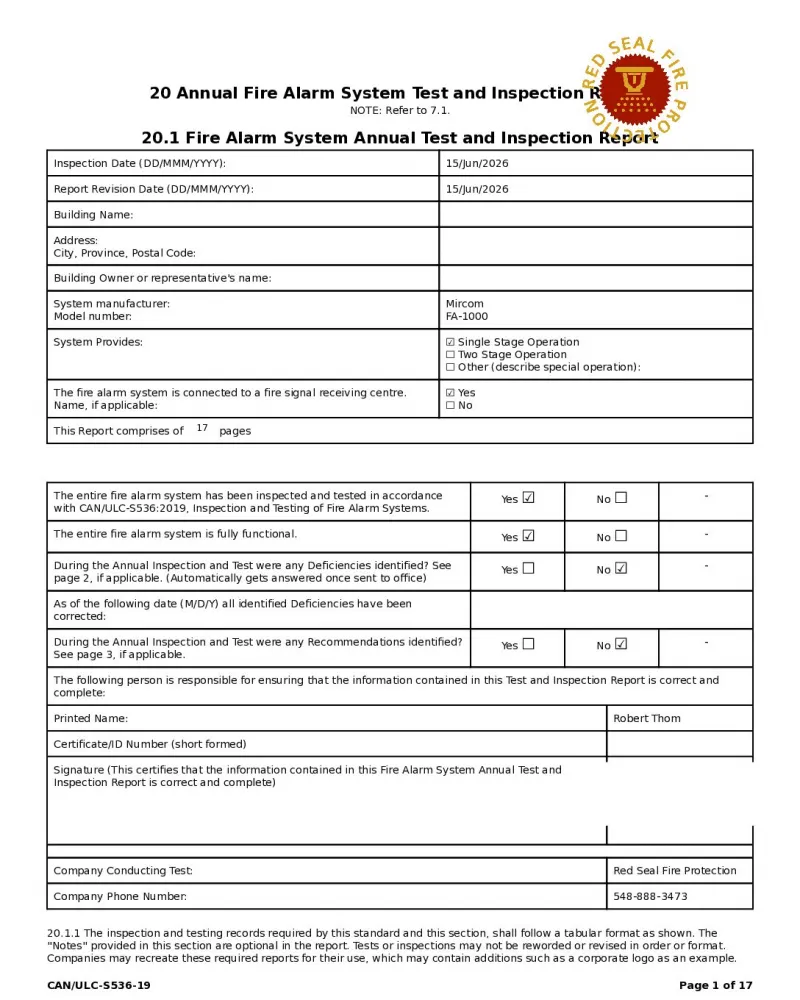
| Annual | Full fire alarm inspection and test: every detector, pull station, horn, strobe and control function, plus the batteries and the monitoring link. Sprinkler annual: sprinklers, pipe, hangers, signs, spare sprinkler cabinet, main drain test, every control valve operated through its full travel. Extinguisher maintenance with a dated tag. Emergency lighting tested for its full rated duration. Fire pump annual flow test. Backflow preventer forward-flow test. Fire safety plan reviewed and contact pages updated. Generator and private hydrant inspected where the building has them. | CAN/ULC-S536:2019; NFPA 25 5.2.1 to 5.2.5, 13.2.5, 13.3.3.1, 8.3.3 and 13.7.2.1; NFPA 10; Ontario Fire Code Division B 2.7.3 and 2.8 | Certified fire alarm technician; licensed sprinkler fitter; extinguisher technician |
Weekly and multi-year items sit outside this table because most buildings do not have them. If the building has a fire pump, the pump room gets a weekly look. A diesel pump also runs at churn for at least 30 minutes every week (NFPA 25 8.2.2 and 8.3.2.4).
Dry sprinkler systems add weekly, quarterly and 3-year items of their own. Every 5 years the pipe gets an internal assessment and the gauges get replaced or calibrated (NFPA 25 14.2.1 and 13.2.7.2). A one-page printable version is available from Red Seal by email.
The reasoning behind each frequency is in how often a commercial building needs a fire inspection in Ontario. The monthly extinguisher row is explained in our fire extinguisher inspection guide.
What does the fire prevention officer look at first when they walk in?
Records. In my experience the inspection starts at the binder and only then moves to the equipment. The reason being, the officer cannot watch a year of monthly checks happen, so the log is the only proof.
Windsor Fire & Rescue Services publishes what it checks for a business licence. Annual items are the fire safety plan review (buildings with more than 30 seats), emergency lighting, portable extinguishers, fire alarm, sprinkler, generator and private hydrant inspections. Every 6 months it is the commercial cooking suppression inspection, with hood cleaning as needed.
Monthly it is extinguisher checks, emergency lighting tests and fire separation door checks. Windsor asks for two years of records on site. Fire safety plan contact pages get updated every year and emailed as a PDF to fpinspectors@citywindsor.ca.
If something fails, the re-inspection fee is $185 plus HST. That is usually the building with the annual report “somewhere at head office”, as opposed to the building with a binder on the wall.
I signed about 40 extinguisher tags in one sitting as an apprentice. I learned that a fire prevention officer can read a pen as well as I can. So do the monthly checks in the month they belong to, and date them that day.
How do you keep the records so the checklist actually proves something?
The Ontario Fire Code requires records of tests, inspections and corrective measures to be kept for two years (Division C, Section 1.1.2). Keep one sheet per system per month with the date, the initials and the result. File contractor reports by system and by year.
Keep a deficiency log with the date each item was found and the date it was fixed. A failed item with no fix date is the most common gap I see. The reason being, the report gets filed and the repair quote gets emailed to someone else.
So pair every report with its repair record before you file either one. Every Red Seal customer gets an online inspection portal with every past report and every deficiency resolution in one place.
The full retention rule is in how long to keep fire inspection records in Ontario. If your building is in Windsor-Essex, the Windsor-Essex service page covers local response times. The contractor side of the table is on the fire system inspections page.
Frequently asked questions
What is on a commercial fire safety checklist in Ontario?
A commercial fire safety checklist lists every fire protection system in the building with the frequency the Ontario Fire Code sets for it. Monthly items are extinguisher checks, emergency lighting tests, fire separation door checks, sprinkler gauge and control valve checks, and the fire alarm monthly test. Quarterly, semi-annual and annual items are the contractor tests under NFPA 25, CAN/ULC-S536:2019, NFPA 10 and NFPA 17A, plus the annual fire safety plan review.
Does a property manager fire inspection checklist replace the contractor’s inspection?
No. The checklist tracks the monthly items your staff do and the dates the contractor items come due. The contractor still performs the quarterly, semi-annual and annual tests and signs the reports. The Ontario Fire Code (Division C, Section 1.1.2) requires those reports to be kept for two years.
How often should fire extinguishers be checked in a commercial building?
Every month by building staff, with a visual check and an initialled tag. Once a year a trained person does the maintenance (NFPA 10, adopted by Ontario Fire Code Division B Section 6.2). Stored-pressure dry chemical extinguishers also need internal maintenance every 6 years and a hydrostatic test every 12 years.
Can building staff do the monthly emergency lighting test?
Yes. The Ontario Fire Code (Division B, Section 2.7.3) requires a monthly test for operation, which is pressing the test button and confirming the heads light. Building staff can do that and log it. The annual test for the full rated duration is normally done by a contractor, because it has to prove the batteries last the whole time.
Is your own checklist pointless when a contractor already handles the inspections?
The contractor owns the quarterly and annual rows, and a good one books them before they are due. The monthly row is yours, because no contractor visits every month unless you pay for 12 visits. The Ontario Fire Code puts responsibility on the owner either way (Division C, Section 1.2).
Red Seal’s Fire Code Compliance Blueprint Inspection includes a 12-month compliance calendar with every date on it, a 48-hour deficiency action plan and the online portal. The checklist and the contractor work from the same page.
That is how 3,000+ inspections have been run in the last few years. The report is in your inbox within 24 hours, guaranteed within 48 hours or 20% comes off the inspection price.
Get every system on one calendar before the inspector arrives. Send your building address to Red Seal and get a fixed-fee inspection quote within 24 hours. Get a fixed-fee quote or call 548-888-FIRE (3473).
Red Seal Fire Protection inspects, tests and repairs fire sprinkler, fire alarm, fire extinguisher, fire pump and backflow systems for commercial, industrial and multi-residential buildings in Windsor-Essex, Chatham-Kent, Sarnia-Lambton and London, Ontario.