Ontario Fire Code Division C Section 1.1.2 requires records of every fire protection test, inspection and corrective measure to be kept for at least two years. Windsor Fire & Rescue Services asks to see those two years on site. NFPA 25 Section 4.3 adds longer rules for sprinklers, standpipes and fire pumps. Acceptance test records and as-built drawings are kept for the life of the system, and each routine record until one year after the next test of the same type. Two years is the floor, and keeping everything in a digital portal is the practical answer.
What does the Ontario Fire Code say about fire inspection records retention?
Okay, so first things first. The Ontario Fire Code puts the record rule in Division C Section 1.1.2. Every test, inspection and corrective measure the Code requires has to be written down, and the record kept for at least two years.
The reason being, the Code is full of frequencies. Monthly extinguisher checks, monthly emergency lighting tests, quarterly sprinkler alarm tests, annual fire alarm inspections. The only way anyone can tell those happened is a dated record with a name on it.
Two years covers the current cycle and the one before it. That lets a fire prevention officer see whether a deficiency was fixed or carried forward. How often each system needs a fire inspection in Ontario lists every one of those cycles.
So what that means is every tag, test sheet and repair invoice is a fire code record, and each one has a two-year shelf life at minimum. Throwing out last year’s binder when the new report arrives is the most common way buildings fall short.
What does NFPA 25 add for sprinkler, standpipe and fire pump records?
For water-based systems the Ontario Fire Code adopts NFPA 25 in Division B Section 6.4, and NFPA 25 has its own record section at 4.3. Records must show what was done, who did it, the result and the date. The owner keeps them and makes them available to the fire department on request.
The big thing is the two retention periods. As-built drawings, the original acceptance tests and the manufacturer data sheets are kept for the life of the system. Every later inspection, test and maintenance record is kept until one year after the next record of the same type.
For an annual main drain test that is two years. For a 5-year internal pipe assessment, it is six. So if a fire pump was installed in 2009, the 2009 acceptance test is still a current record today, as opposed to history.
Our NFPA 25 sprinkler inspection requirements guide lays out every frequency those records have to match.
Which records count, and how long should you keep each one?
| Record | Ontario Fire Code minimum (Division C 1.1.2) | NFPA 25 Section 4.3 (water-based systems only) |
|---|---|---|
| Annual sprinkler inspection and main drain test report | 2 years | 1 year after the next annual report |
| Quarterly waterflow and supervisory alarm test | 2 years | 1 year after the next quarterly test |
| 5-year internal pipe assessment | 2 years | 1 year after the next 5-year assessment |
| Fire pump weekly churn log and annual flow test | 2 years | 1 year after the next test of that type |
| Backflow preventer annual forward-flow test | 2 years | 1 year after the next annual test |
| Acceptance tests, as-built drawings, hydraulic placard data, sprinkler data sheets | 2 years | Life of the system |
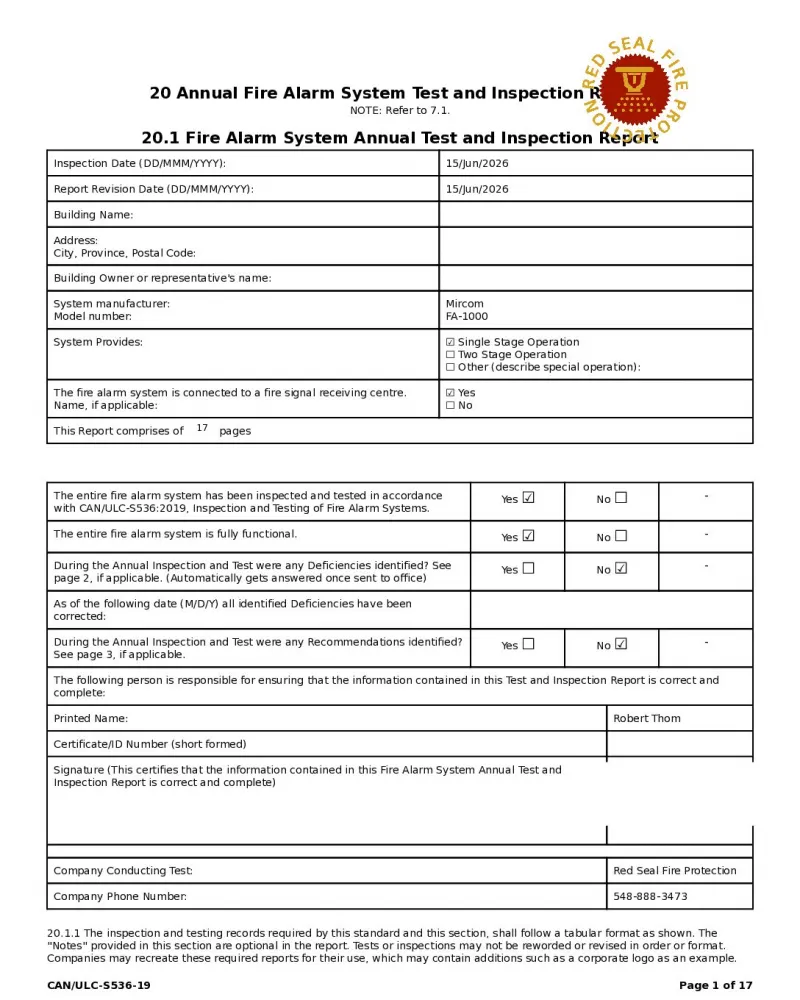
| Fire alarm annual inspection report (CAN/ULC-S536:2019) | 2 years | Not covered by NFPA 25 |
| Fire alarm verification report (CAN/ULC-S537:2019) | 2 years | Not covered; keep for the life of the system |
| Extinguisher monthly checks, annual maintenance, 6-year and 12-year records (NFPA 10) | 2 years | Not covered by NFPA 25 |
| Emergency lighting monthly and annual tests | 2 years | Not covered by NFPA 25 |
| Fire drills and staff instruction | 2 years | Not covered by NFPA 25 |
| Deficiency repairs and other corrective measures | 2 years | 1 year after the next related test |
| Fire watch and impairment logs | 2 years | Tagged and recorded under Chapter 15 |
I would say the right-hand column is the floor for sprinkler records, and life-of-the-building is the practical rule for all of it. A PDF costs nothing to keep. A missing one costs an afternoon of phone calls at best.
What does Windsor Fire & Rescue ask to see on site?
One thing to know: in Windsor the record rule has teeth at business licence time. Windsor Fire & Rescue Services lists two years of records kept on site as part of its business licence inspection. That sits next to the annual fire alarm, sprinkler, extinguisher and emergency lighting inspections on the same list.
On site means in the building, as opposed to at your contractor’s office or a head office in another city. The same page lists the monthly items you record yourselves: extinguisher checks, emergency lighting tests and fire separation door checks. Those are the records most often missing, because nobody is invoiced for them.
A re-inspection, when something is missing, carries a fee of $185 plus HST. Questions about the list can go to firesafety@citywindsor.ca.
I have been handed a binder with a tab for one year and nothing after it, two days before a licence inspection. The inspections had been done. The reports were sitting in three different inboxes.
So the two years on site is a filing rule as much as an inspection rule. The work was done; the record was not where the inspector could see it.
Who is entitled to ask for your Fire Code records?
The fire prevention officer is entitled to ask at any inspection under the Fire Protection and Prevention Act, 1997. In Windsor that is Windsor Fire & Rescue Services. Your insurer is entitled to ask at a loss-control visit and after a loss, a buyer’s lawyer is entitled to ask in due diligence, and a tenant is entitled to ask what protects their space.
The reason being, the owner is responsible for compliance under Ontario Fire Code Division C Section 1.2. The records are the only evidence that the responsibility was met. A contractor’s word is not a record; a dated report with a technician’s name, the result and the corrective measure is.
So, as opposed to hoping nobody asks, build the file so the answer to every request is a link. What a fire inspection report should include describes what each of those records needs to contain.
How does a digital inspection portal keep you audit-ready?
Every Red Seal customer gets an online inspection portal with every past report and every deficiency resolution. Each fire system inspection report is code-cited, with photos and a list of every sprinkler, detector and pull station tested. So the record shows what was tested, as opposed to a tag that says something was.
So what that means is the two-year rule takes care of itself. The current report and the one before it sit in the same place as the five before that. A fire prevention officer or an adjuster who asks for a past year gets it in an email, and you can see the format on our sample report page.
The monthly records your own staff keep still need a home. Print the portal report for the binder and keep the monthly checklists behind it. That is the on-site file Windsor asks for.
Frequently asked questions
How long do you have to keep fire inspection records in Ontario?
At least two years, under Ontario Fire Code Division C Section 1.1.2, for every required test, inspection and corrective measure. For sprinklers, standpipes and fire pumps, NFPA 25 Section 4.3 keeps acceptance records for the life of the system and each routine record until one year after the next one of its type. Windsor Fire & Rescue Services asks to see two years on site.
What counts as fire code records?
Any record of a test, inspection or corrective measure the Ontario Fire Code requires. That includes fire alarm and sprinkler inspection reports, extinguisher tags, emergency lighting test sheets, kitchen suppression reports, fire drill records, fire watch logs and the invoices or reports that show a deficiency was fixed. The record needs the date, what was done, who did it and the result.
Do fire inspection records have to be kept on site?
The Ontario Fire Code requires the records to be kept and made available, and Windsor Fire & Rescue Services asks for two years of records on site at business licence inspections. A digital copy you can open on a phone in the building meets most requests. A printed binder removes any argument.
Can my fire protection contractor keep the records for me?
Your contractor should keep copies, and a good one gives you a portal with every report. The duty to keep the records is the owner’s under NFPA 25 Section 4.3 and the Ontario Fire Code, so the file has to be yours and reachable without the contractor. If you change contractors, download everything before the portal access ends.
Does the contractor’s copy not count as your record?
It counts as the contractor’s record. The Ontario Fire Code places the duty on the owner, and the fire prevention officer standing in your building asks you, not your contractor, for two years of records.
Red Seal gives every customer an online portal with every past report and deficiency resolution. Each report lands within 24 hours of the inspection, guaranteed within 48 hours or 20% comes off the inspection price.
That is more than 3,000 fire inspections in the last few years across Windsor-Essex, Chatham-Kent, Sarnia-Lambton and London, each one filed where the owner can reach it. The record exists before the truck is back in the yard.
Put two years of fire code records in one place before the next inspection. Send your building address to Red Seal and get a fixed-fee inspection quote within 24 hours. Get a fixed-fee quote or call 548-888-FIRE (3473).
Red Seal Fire Protection inspects, tests and repairs fire sprinkler, fire alarm, fire extinguisher, fire pump and backflow systems for commercial, industrial and multi-residential buildings in Windsor-Essex, Chatham-Kent, Sarnia-Lambton and London, Ontario.