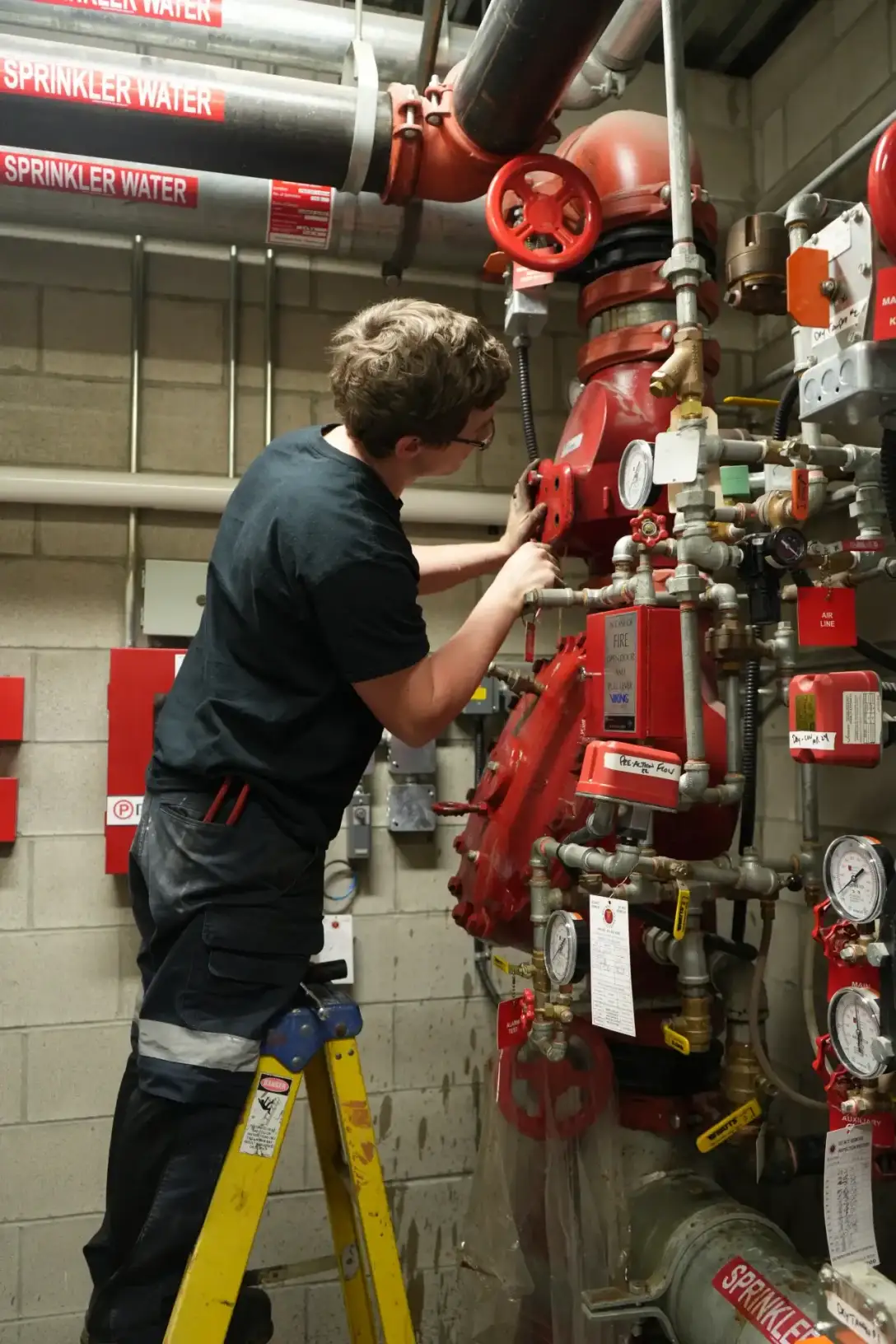
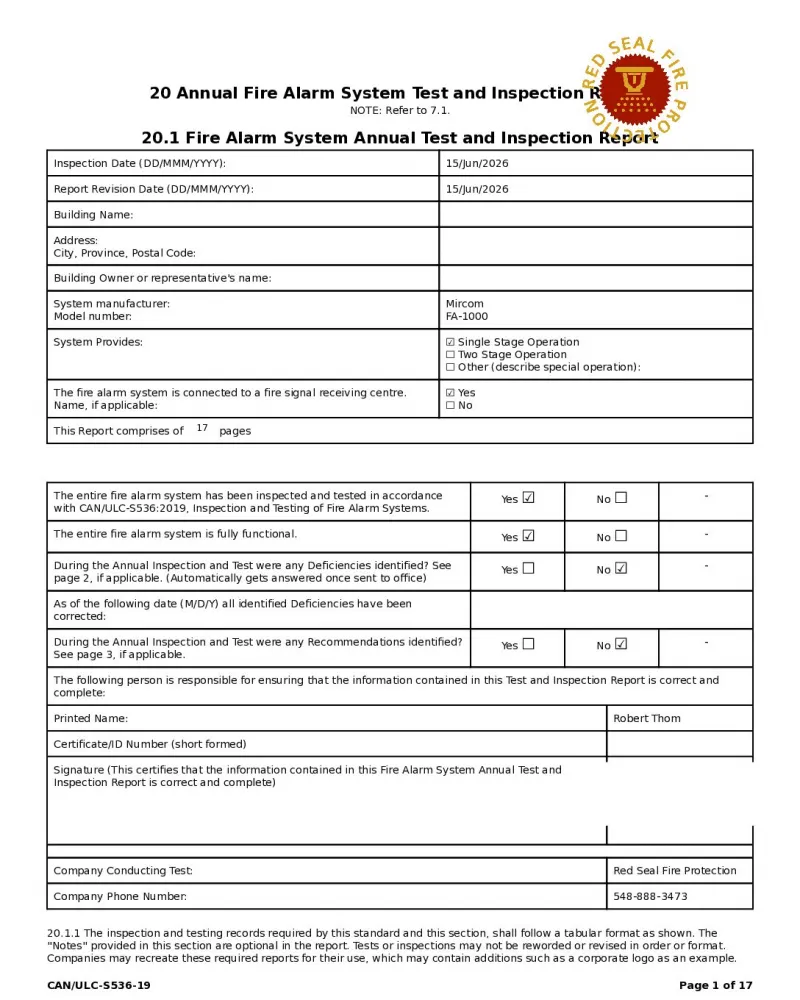
A fire inspection report should include the building address and inspection date, and each system with the standard it was tested to (NFPA 25, CAN/ULC-S536:2019 or NFPA 10). It lists every detector, pull station, valve and extinguisher with its result, and the test readings such as main drain pressures. It carries a deficiency list that cites the clause each item fails, photos, and the name and qualification of the technician who signed it. The owner keeps it for two years under Division C Section 1.1.2 of the Ontario Fire Code. A tag on the riser does not meet that bar.
What sections does a fire inspection report need?
Okay, so first things first. A fire inspection report is a record, and the Ontario Fire Code treats it as one.
Division C Section 1.1.2 requires records of tests, inspections and corrective measures to be kept for two years. NFPA 25 asks the owner to keep records that show what was done, by whom, and what was found (4.3).
The reason that matters is that two different people will read the report, and they read it for different things. A fire prevention officer reads it to confirm the Code was followed. An insurer’s loss-control reviewer reads it to see whether the systems would work on the day of a fire.
Here are the eight sections that satisfy both, and who is entitled to ask for each.
| Section | What it holds | Who asks for it |
|---|---|---|
| 1. Building and visit | Address, date, your contact, the technician’s name and qualification, time on site | Fire prevention officer; insurer |
| 2. Systems and standards | Each system inspected, with the standard and edition it was tested to: NFPA 25, CAN/ULC-S536:2019, NFPA 10, and the Ontario Fire Code section that adopts it | Both |
| 3. Item list | Every detector, pull station, signal, sprinkler zone, control valve, fire pump and extinguisher, by location, with pass or fail beside each | Fire prevention officer, since CAN/ULC-S536:2019 is tested one item at a time |
| 4. Test readings | Main drain static and residual pressures, fire pump flow test points, backflow forward-flow result, waterflow alarm time, emergency lighting duration | Insurer loss-control; NFPA 25 records (4.3) |
| 5. Deficiency report | Each item that failed, the clause it fails, a photo, the risk, and a recommended repair | Both |
| 6. Corrective measures | What was fixed, when, by whom, with the invoice reference | Fire prevention officer under Division C Section 1.1.2 |
| 7. Next due dates | The next quarterly, semi-annual, annual and 5-year items, with dates | Insurer loss-control; your own calendar |
| 8. Signatures | Technician and customer sign-off, with the date | Both |
Section 3 is the one most reports skip, because it is the longest. A fire alarm report that says “all tested, pass” has not listed anything. CAN/ULC-S536:2019 tests the system one detector, one pull station and one signal at a time, and the report should read the same way.
So a report has eight sections or it has gaps. The gaps are where the questions come from.
What does a proper deficiency report look like?
The big thing is this: a deficiency report is a list of clauses, as opposed to a list of opinions. Each line names the item, where it is, the clause it fails, and what fixes it. “Sprinkler heads in the warehouse need attention” is an opinion, and “Six sprinklers in Bay 3 loaded with paint overspray, NFPA 25 5.2.1.1.1, replace” is a deficiency.
The reason being that a clause can be checked and an opinion cannot. A fire prevention officer can open NFPA 25 to 5.2.1.1.1 and see the requirement. So can your insurer, and so can the contractor who quotes the repair.
A plant manager in Sarnia-Lambton once handed me three years of reports from a previous contractor. Every one said “deficiencies noted, see technician”. There were no clauses, no photos and no record of what had been fixed, and Sarnia Fire Rescue Services would have been entitled to ask for all three.
So what that means is the deficiency report is the part of the document that does the work. Our post on how to prioritize fire inspection deficiencies shows what to do with it once it is written properly.
Why do so many fire inspection reports fall short in an insurance review?
One thing to know: a loss-control reviewer is not grading the building. The reviewer is checking whether the paper proves the systems were tested, and whether what was found got fixed. Most reports fall short because they prove the visit and nothing else.
Here is what the reviewer is entitled to ask to see. The item count, so a 212-head fire alarm has 212 lines. The readings, so a main drain test shows a static and a residual pressure, as opposed to the word “pass”.
The deficiency closure, so an item flagged in March shows a repair in April. I would say the most common gap is the readings. A main drain test with no pressures written down cannot be compared to last year.
A drop in residual pressure from one year to the next is an early sign of a closed or obstructed supply. That is the kind of trend a reviewer looks for, and our post on fire suppression systems and insurance covers what else they tend to ask about.
So a report that fails a review usually failed on paper, with systems that may have been fine. The fix is the format.
Is there a fire inspection report template you can check yours against?
Honest answer: the best fire inspection report template is a real report with the names blacked out. Red Seal publishes one. Our sample report is a redacted inspection from a real building, with every one of the eight sections in it, so you can hold your current report beside it page by page.
Use it as a checklist: does your report list every item, or does it say “all tested”? Does it show main drain pressures? Does each deficiency cite a clause and carry a photo?
If the answer to any of those is no, the report is a certificate, as opposed to a record. The certificate says a technician came. The record says what they found.
So download the sample, open your last report, and compare the two side by side. It takes about 10 minutes, and it tells you what the reviewer will see before the reviewer does.
How fast should the report arrive, and where should it live?
The report should arrive within 24 hours of the visit. The reason being that a deficiency found on Tuesday is an impairment on Tuesday, and a report that arrives 3 weeks later has left the building unprotected for 3 weeks with nobody told. Red Seal delivers the report within 24 hours, and guarantees it within 48 hours or 20% comes off the inspection price.
Where it lives matters as much. Division C Section 1.1.2 wants two years of records on site, and Windsor Fire & Rescue Services confirms it asks to see two years. Every Red Seal customer gets an online inspection portal with every past report and every deficiency resolution, so the two years are one login, as opposed to a binder in an office that moved.
So the report comes fast, and it stays findable. Those two things are most of what a review is checking for.
Frequently asked questions
What is a fire inspection report template, and should I use one?
A fire inspection report template is the fixed set of sections a contractor fills in on every visit, so no report is missing an item list, test readings or a deficiency page. You should ask to see your contractor’s template before the first inspection, and compare it to a redacted real report. The sections that matter are the ones a fire prevention officer or an insurer is entitled to ask for. That means every item tested, every reading, every deficiency with its clause under NFPA 25, CAN/ULC-S536:2019 or NFPA 10, and every repair recorded.
What should a deficiency report include?
Each deficiency should show the system, the location, the clause it fails under NFPA 25, CAN/ULC-S536:2019 or NFPA 10, a photo, the risk, and a recommended repair. It should also leave room for the corrective measure, so the same page shows the fix once it is done. Division C Section 1.1.2 of the Ontario Fire Code requires that corrective measure to be kept on record for two years.
Does a fire inspection report have to be signed by a licensed technician in Ontario?
The report should carry the name and qualification of the person who did the test, and that person signs it. Sprinkler, standpipe and fire pump work in Ontario is done by a licensed sprinkler fitter, and fire alarm testing to CAN/ULC-S536:2019 is done by certified fire alarm technicians. A report with no name on it gives a fire prevention officer no way to confirm who did the work.
How long do I keep a fire inspection report in Ontario?
Two years, under Division C Section 1.1.2 of the Ontario Fire Code, which covers records of tests, inspections and corrective measures. Windsor Fire & Rescue Services asks to see those two years on site. Keeping the reports in an online portal meets the requirement as long as you can produce them when asked.
Is the signed tag on the riser not enough?
A tag proves a technician stood at the riser on a date, and nothing else. A fire prevention officer is entitled to two years of records under the Ontario Fire Code, an insurer’s reviewer is entitled to the readings, and a tag has neither.
After 3,000+ inspections in the last few years, every Red Seal report carries all eight sections. The redacted sample report is on our site, and yours lands in the portal within 24 hours of the visit, as our fire system inspections page explains.
Get a report that holds up in a review. Send your building address to Red Seal and get a fixed-fee inspection quote within 24 hours. Get a fixed-fee quote or call 548-888-FIRE (3473).
Red Seal Fire Protection inspects, tests and repairs fire sprinkler, fire alarm, fire extinguisher, fire pump and backflow systems for commercial, industrial and multi-residential buildings in Windsor-Essex, Chatham-Kent, Sarnia-Lambton and London, Ontario.