What to do about fire inspection deficiencies comes down to sorting before pricing. First, fix anything that stops a system working or stops people getting out: a closed sprinkler control valve, a fire alarm panel in trouble, a blocked exit. Second, fix items the Ontario Fire Code gives a deadline or the fire department has ordered. Third, fix items that affect insurance and reliability, like an overdue 5-year NFPA 25 internal pipe assessment. Fourth, everything else. Record each repair, because the Ontario Fire Code requires two years of records, and get every item priced within 48 hours.
What does a deficiency on a fire inspection report actually mean?
Okay, so first things first. A deficiency is one item that did not meet the standard the system was inspected to. For sprinklers, standpipes and fire pumps that standard is NFPA 25, for fire alarms it is CAN/ULC-S536:2019, and for extinguishers it is NFPA 10.
The reason it matters is that a deficiency report from a fire inspection is a private document. Your contractor wrote it, you hold it, and the fire department has not seen it. It only becomes a problem when a fire prevention officer asks for your two-year record under Division C Section 1.1.2 of the Ontario Fire Code and the same items are still open.
A good deficiency report cites the clause each item fails, as opposed to a line that says “sprinkler heads need attention”. If yours does not, ask for the clause. We cover the format in what a fire inspection report should include.
So the list is yours for now. What you do with it in the next 48 hours decides whether it stays that way.
Which fire inspection deficiencies have to be fixed first?
The big thing is this: a deficiency that stops a system from working, or stops people from getting out, goes first and goes today. Everything else waits behind it.
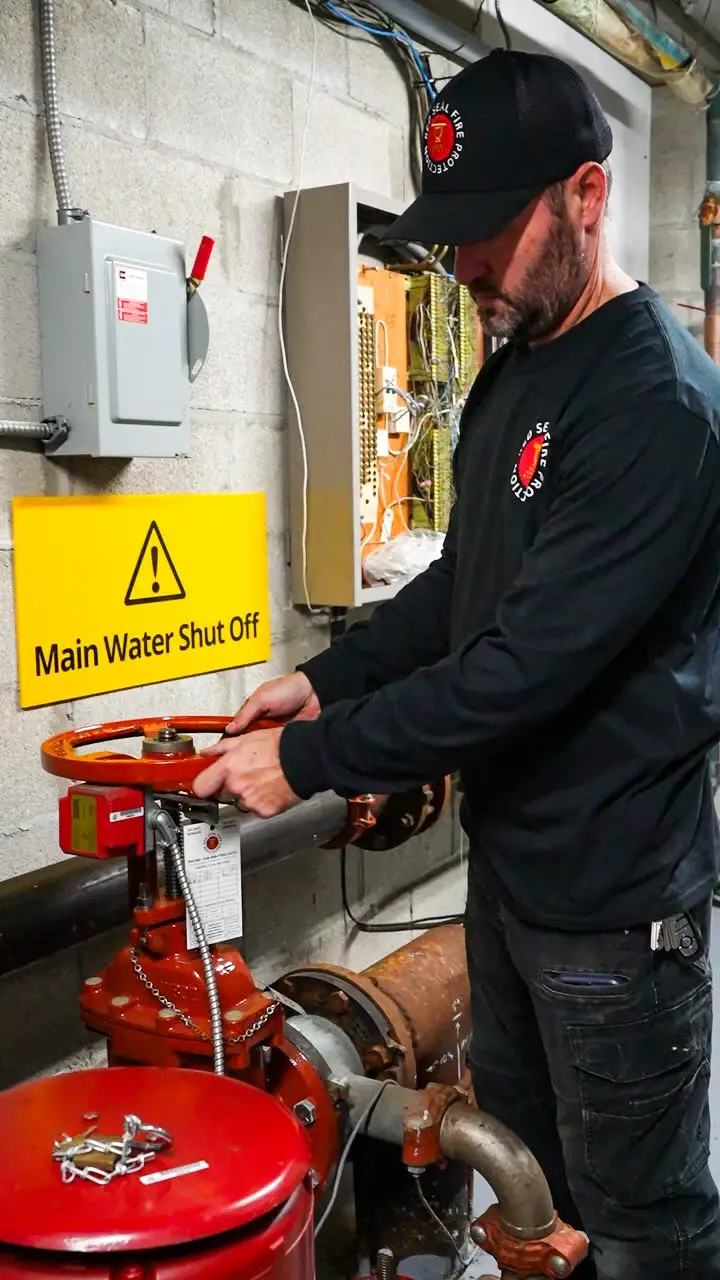
A closed sprinkler control valve means the sprinklers above it have no water. A fire alarm panel in trouble with the monitoring station disconnected means nobody is coming. A missing extinguisher in a commercial kitchen, a blocked exit door, an exit sign that is dark, or a fire pump that will not start all belong in the same group.
I have walked into a warehouse in Chatham-Kent where the control valve had been closed for a plumbing repair 7 weeks earlier and never reopened. The annual report had the valve flagged on page 2. Nobody had read page 2, and Chatham-Kent Fire & Rescue would have been entitled to ask why.
So what that means is any item in this group is an impairment. NFPA 25 Chapter 15 covers impairments, and a fire watch is among the recommended actions in 15.5.2 until the system is back. Tell the fire department and your monitoring station the system is impaired, and get a technician on site the same day, as opposed to the next scheduled visit.
What goes in the second, third and fourth groups?
One thing to know: once the life-safety items are moving, the rest of the list sorts itself by who is waiting on it. The Code and the fire department set hard dates, your insurer and the system’s own reliability set softer ones, and the rest is housekeeping.
| Group | The test | Examples | When it gets fixed |
|---|---|---|---|
| 1. Life safety | Does it stop a system working, or stop people getting out? | Closed control valve; fire alarm panel in trouble or silenced; fire pump that will not start; missing or discharged extinguisher; blocked exit; dark exit sign | Same day. Treated as an impairment under NFPA 25 Chapter 15 until closed |
| 2. Code deadline or order | Has the Ontario Fire Code or a fire prevention officer set a date? | Items on a fire inspection order; overdue annual CAN/ULC-S536:2019 test; annual emergency lighting duration test missed under Division B Section 2.7.3; annual NFPA 10 maintenance lapsed | By the date on the order, or before the next scheduled test |
| 3. Insurance and reliability | Will it come up in a loss-control review, or make the system fail later? | 5-year internal pipe assessment overdue (NFPA 25, 14.2.1); gauges past 5 years (13.2.7.2); corroded hangers (5.2.3); extinguisher 6-year or 12-year service due; backflow forward-flow test not done (13.7.2.1) | Before the next annual visit, or sooner if the insurer has asked |
| 4. Everything else | Does it affect records, labels or housekeeping only? | Missing hydraulic placard (5.2.5); spare sprinkler cabinet short a head (5.2.1.4); faded signs; storage too close to sprinklers; missing valve tag | Bundled into the next scheduled visit |
Group 2 is where most orders come from. Our post on what happens if you fail a fire inspection in Ontario walks through the order and the re-inspection.
Group 3 is the one property managers push to next year, and the one that costs the most when it comes due. A 5-year internal pipe assessment that finds obstruction is a repair. The same pipe found 3 years later is a replacement, and our list of common fire sprinkler system failures shows how that happens.
So the table is a sort, as opposed to a grade. Everything on it gets fixed. The groups only decide the order.
How do you get a Fire Code deficiency repair done without a second round of visits?
Honest answer: price the whole list at once, and send the technician who found the problem to fix it. Most of the delay in fire code deficiency repair is in the handoff, where the inspection company flags an item and a different company quotes it 3 weeks later.
The fix is a priced repair path for every item on the report, delivered within 48 hours of the inspection. You approve the groups you can fund now, you know the number before the truck rolls, and you are never billed above the approved quote. The technician comes with the parts for the group 1 items, because those were known on the day of the inspection.
That is as opposed to the long way, where each item becomes its own purchase order. The owner of a 3-building portfolio told me his previous contractor’s deficiency list had 11 items and took 5 months to close, because each item went out for a separate quote. The second year, every item was priced in one document and closed in 3 weeks.
So ask your contractor two questions. Can you price every item within 48 hours, and can the same technician do the repair? If the answer to either is no, the list will sit, and our sprinkler maintenance page explains how we close it instead.
How do you prove each deficiency is closed?
The proof is a record, because Division C Section 1.1.2 of the Ontario Fire Code requires records of corrective measures for two years, right beside the inspection records. For each item, keep the repair invoice, a photo of the item after the fix, and the updated report line that shows it passing.
A fire prevention officer is entitled to ask for that record, and so is an insurer’s loss-control reviewer. If the item was on a fire inspection order, bring the three pieces to the re-inspection. In Windsor, Windsor Fire & Rescue Services charges $185 plus HST for a re-inspection, and a ready file is the difference between one fee and two.
Every Red Seal customer gets an online inspection portal with every past report and every deficiency resolution in it. So the two-year record is one login, as opposed to a binder somebody took home.
Frequently asked questions
What should a deficiency report from a fire inspection include?
Each deficiency should name the system, the location, the clause it fails under NFPA 25, CAN/ULC-S536:2019 or NFPA 10, a photo, and a recommended repair. A report that lists “deficiencies noted” with no clause gives you nothing to prioritize and nothing to show a fire prevention officer. Ask the contractor to cite the clause for every item before you price anything.
How long do you have to fix fire inspection deficiencies in Ontario?
The Ontario Fire Code does not set one blanket deadline for a contractor’s deficiency list. An impairment, such as a closed valve or a fire alarm out of service, needs action the same day under NFPA 25 Chapter 15, with a fire watch among the recommended steps. A fire inspection order sets its own date for each item, and that date is the one that counts.
Who can do fire code deficiency repair on a sprinkler system?
Sprinkler repairs in Ontario are done by a licensed sprinkler fitter, and the repair is recorded as a corrective measure under Division C Section 1.1.2 of the Ontario Fire Code. Fire alarm repairs are done by certified fire alarm technicians, and a change to the system may need a CAN/ULC-S537:2019 verification. Extinguisher maintenance is done by a trained person under NFPA 10.
Does a deficiency mean the building failed its fire inspection?
No. A deficiency means one item did not meet the standard on the day of the test, and the report is between you and your contractor. The building has a problem with the fire department only when a fire prevention officer finds the same item open and writes an order. Closing the list, and recording each fix, is what keeps it from getting there.
Is every item on the list really urgent?
No, and treating them all the same is why lists sit: a closed valve is urgent today, a 5-year test is urgent this quarter, and a missing placard can wait for the next visit. After 3,000+ inspections in the last few years, the buildings with short lists are the ones that priced every item within 48 hours and fixed them in order. Red Seal’s report comes within 24 hours, guaranteed within 48 hours or 20% comes off the price, and every item on it has a priced repair path.
Get every deficiency priced within 48 hours. Send your building address to Red Seal and get a fixed-fee inspection quote within 24 hours. Get a fixed-fee quote or call 548-888-FIRE (3473).
Red Seal Fire Protection inspects, tests and repairs fire sprinkler, fire alarm, fire extinguisher, fire pump and backflow systems for commercial, industrial and multi-residential buildings in Windsor-Essex, Chatham-Kent, Sarnia-Lambton and London, Ontario.